
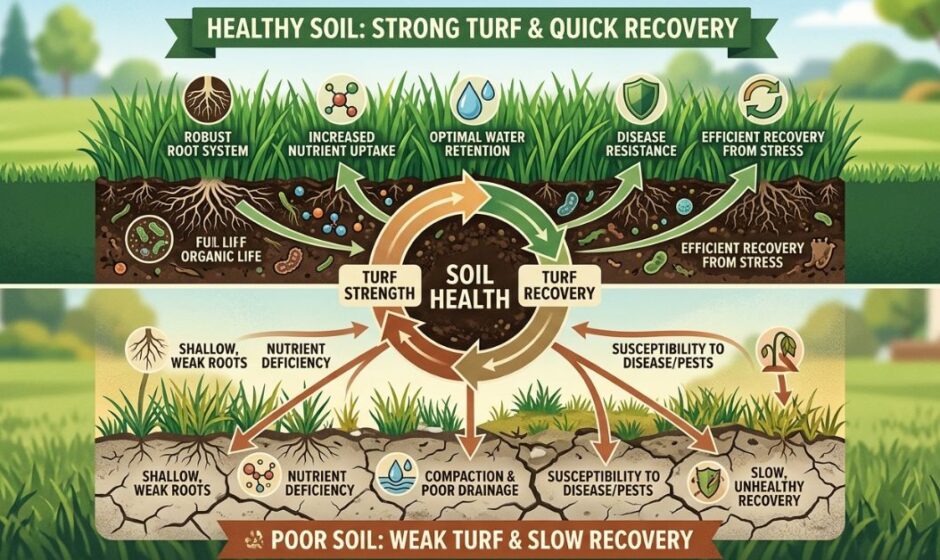

Healthy turf starts long before a single blade of grass appears above ground. The real story happens beneath the surface, in the complex ecosystem of soil that feeds, anchors, and protects your lawn. Whether you manage a residential garden, a sports field, or a commercial landscape, understanding how soil health directly affects turf strength and recovery is one of the most valuable things you can do for long-term results.
Most lawn problems that appear on the surface, including thin patches, slow regrowth, disease vulnerability, and compaction damage, trace back to poor soil conditions below. This article breaks down the science and the practical steps so you can build turf that performs well and bounces back fast.
Why Soil Is the Foundation of Turf Health
Soil is not simply dirt. It is a living system made up of minerals, organic matter, water, air, and billions of microorganisms that work together to support plant life. When this system is functioning well, grass plants receive the nutrients, moisture, and oxygen they need to develop deep root systems and strong leaf tissue.
Weak or degraded soil produces weak turf. Grass grown in compacted, nutrient-depleted, or biologically dead soil cannot maintain density under foot traffic, recover from drought stress, or fight off fungal disease. This is why soil management is not optional, but foundational.
If you are looking for expert guidance on turf care backed by real-world experience, barthturf offers a wealth of resources that cover both professional and DIY turf management from the ground up.
Soil Structure and How It Influences Root Development
Soil structure refers to the way individual soil particles are arranged and clustered together. Good structure means there are enough pore spaces for air and water to move freely through the profile. Roots grow through these pores and access the oxygen they need for cellular respiration.
Compacted soil closes off these pore spaces. Roots cannot penetrate dense, compressed layers and end up growing shallow and sideways. Shallow roots cannot anchor grass firmly or access deep moisture reserves during dry periods. The result is turf that wilts quickly, pulls up easily, and recovers slowly after stress.
Improving soil structure through aeration, organic matter addition, and reduced heavy traffic directly translates to deeper rooting and stronger, more resilient grass.
The Role of Organic Matter in Turf Recovery
Organic matter is one of the most important drivers of turf health. It improves water retention in sandy soils, improves drainage in clay soils, feeds beneficial microbes, and releases nutrients slowly over time. Even a modest increase in organic matter content can dramatically change how quickly turf recovers from damage.
Soils with higher organic matter content tend to have better buffering capacity, meaning they handle temperature extremes, waterlogging, and drought more effectively. When turf is damaged by heavy use, pest activity, or weather events, the microbial activity associated with organic-rich soils speeds up the decomposition of dead plant material and the cycling of nutrients back into the root zone.
Soil Nutrients and Their Direct Impact on Turf Strength
Grass requires a range of macro and micronutrients to grow and stay healthy. Nitrogen, phosphorus, and potassium are the three primary nutrients, but secondary nutrients like calcium, magnesium, and sulfur, along with trace elements like iron and manganese, all play supporting roles in turf performance.
Nitrogen and Leaf Tissue Density
Nitrogen is the nutrient most directly linked to the green, dense appearance of healthy turf. It drives cell division and protein synthesis in leaf tissue. Sufficient nitrogen keeps turf thick and competitive against weeds, while nitrogen deficiency leads to pale, thin, slow-growing grass that lacks the density to handle wear.
However, excessive nitrogen is equally damaging. Too much causes rapid, soft growth that is more susceptible to disease and stress. The goal is a balanced, steady supply that supports consistent, quality growth rather than sudden bursts.
Phosphorus and Root System Strength
Phosphorus supports energy transfer within the plant and is essential for strong root development. Young turf and newly seeded areas rely heavily on available phosphorus to establish a functional root system before the above-ground portion of the plant becomes established.
Mature turf with phosphorus deficiency tends to have a thin root system that cannot anchor properly or access deep soil moisture. Testing your soil phosphorus levels before seeding or overseeding is a practical step that prevents this issue before it develops.
Potassium and Stress Tolerance
Potassium is often called the stress nutrient because it regulates the internal water balance of grass plants, strengthens cell walls, and improves tolerance to both heat and cold. Turf with adequate potassium is noticeably more resilient to drought, wear, and temperature fluctuations than turf growing in potassium-deficient soil.
This is particularly relevant for sports fields and high-traffic lawn areas where the grass faces repeated physical stress. Potassium helps grass recover between uses and maintains its structural integrity under pressure.
Soil pH and Nutrient Availability
Even in a nutrient-rich soil, the wrong pH can lock those nutrients away from grass roots entirely. Turf grasses generally perform best in a soil pH range of 6.0 to 7.0, where the availability of most essential nutrients is at its highest.
What Happens Outside the Optimal pH Range
When soil pH drops below 6.0, phosphorus becomes chemically bound to iron and aluminium compounds and is no longer plant-available. Acidic conditions also favour the growth of moss and certain weeds over grass. In strongly acidic soils, manganese and aluminium can reach toxic concentrations that damage roots.
Alkaline soils above 7.5 create a different set of problems. Iron and manganese deficiencies become common, leading to yellowing and reduced vigour. Beneficial soil bacteria are less active in strongly alkaline conditions, slowing nutrient cycling.
Applying lime to raise pH or sulphur to lower it, based on a reliable soil test, is one of the highest-return investments you can make in turf performance.
Soil Testing as a Starting Point
A basic soil test gives you pH, organic matter percentage, and macro-nutrient levels. This data takes the guesswork out of fertiliser programmes and amendment decisions. Many turf problems that seem mysterious on the surface become straightforward to solve once you have soil data in hand.
Soil tests are inexpensive, widely available, and should be repeated every two to three years to track changes and adjust your management programme accordingly.
Biological Activity and the Living Soil
The billions of microorganisms that live in healthy soil are not passive. Bacteria, fungi, nematodes, earthworms, and other soil life actively transform organic matter into plant-available nutrients, build soil structure, suppress pathogens, and support root health in ways that no synthetic programme can fully replicate.
Mycorrhizal Fungi and Turf Root Networks
Mycorrhizal fungi form a symbiotic relationship with grass roots, extending the effective surface area of the root system far beyond what the plant could achieve alone. In exchange for carbohydrates from the plant, these fungi deliver water and phosphorus from a much wider volume of soil.
Turf with healthy mycorrhizal associations is consistently more drought-tolerant and nutrient-efficient than turf grown in biologically depleted soil. Avoiding excessive synthetic fungicide and fertiliser use helps preserve these networks and allows them to develop naturally over time.
Earthworms and Natural Aeration
Earthworms are a reliable indicator of healthy soil. As they move through the soil profile, they create channels that improve water infiltration and air exchange. Their castings are rich in plant-available nutrients and beneficial microbes. A high earthworm population means your soil is biologically active and structurally sound.
Soils that are repeatedly compacted, heavily treated with pesticides, or stripped of organic matter tend to have very low earthworm populations. Restoring organic matter and reducing chemical inputs allows earthworm populations to recover, which in turn improves overall soil function.
Practical Steps to Improve Soil Health for Stronger Turf
Understanding the relationship between soil and turf is only useful if it leads to action. The following practices consistently produce measurable improvements in turf strength and recovery speed.
Core aeration should be carried out at least once per year on high-traffic areas and every two years on low-traffic lawns. It relieves compaction, improves gas exchange, and creates pathways for water and amendments to reach the root zone.
Topdressing with compost adds organic matter, feeds soil biology, and gradually improves soil structure. Even a thin layer applied annually after aeration produces compounding benefits over several seasons.
Balanced fertilisation based on soil test results ensures that nutrients are applied where they are actually needed rather than by guesswork. This improves efficiency, reduces waste, and prevents the imbalances that weaken turf over time.
pH correction based on test data resolves hidden nutrient availability issues that no amount of fertiliser can overcome if the pH is wrong.
Reducing compaction sources where possible, including limiting heavy machinery use on wet soil and distributing foot traffic patterns, protects soil structure between management events.
Conclusion
Soil health is not a background detail of turf management. It is the central factor that determines how strong your turf grows, how quickly it recovers from stress, and how well it resists the pressures of regular use and seasonal change. Compaction, nutrient imbalance, pH problems, and biological depletion all show up eventually as visible turf decline, but they start below ground long before the symptoms appear on the surface.
Investing in soil health through regular testing, aeration, organic matter management, and biological support builds turf that does not just look healthy but actually performs at a higher level under real conditions. The grass above ground is only as good as the soil beneath it.
Read Also: Seasonal Turf Care Mistakes That Lead to Year-Round Damage