
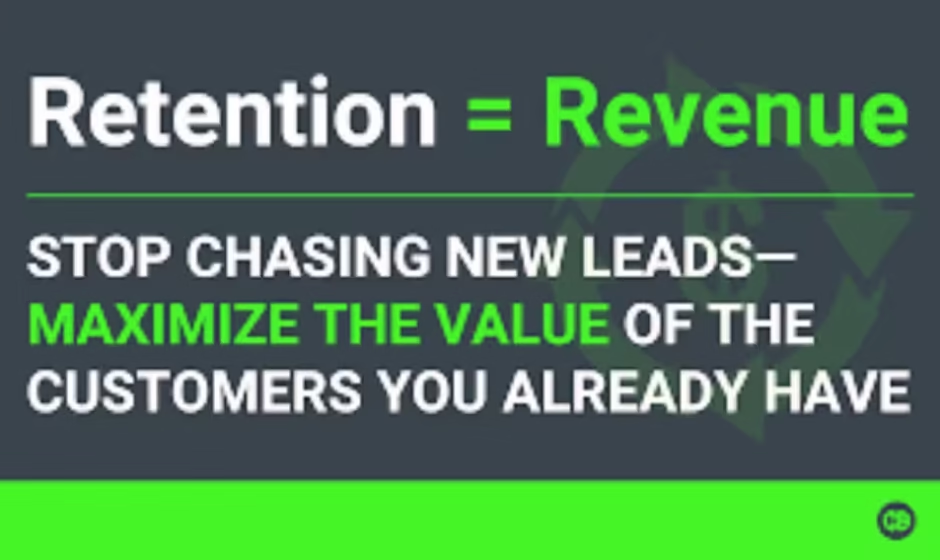

The Real Cost of Chasing New Leads
Most businesses pour the bulk of their marketing budget into bringing in new leads. Ads, cold outreach, landing page tests, paid campaigns, the list keeps growing. Meanwhile, the people who already bought from you sit on the sidelines, waiting for a reason to come back. That gap is where a lot of revenue quietly slips away.
Customer retention is often treated as a secondary priority, but the numbers tell a different story. Keeping existing customers engaged is cheaper, faster, and far more profitable than constantly running after strangers. If your growth has plateaued, the fix might not be a bigger ad budget. It might be the customer list you already have.
New customer acquisition is expensive, and it gets more expensive every year. Ad platforms are crowded, organic reach keeps shrinking, and cost-per-click on common keywords has climbed across almost every industry. By some estimates, acquiring a new customer can cost five to seven times more than keeping an existing one.
That cost is not just in ad spend. It also shows up in the time your sales team spends nurturing cold contacts, the content pieces built for people who may never convert, and the discounts offered to pull in first-time buyers. Every dollar chasing leads is a dollar not spent on the people already paying you.
When you look at it that way, the math becomes hard to ignore. A constant focus on new leads turns your business into a leaky bucket. You pour water in at the top while the bottom keeps draining.
What Retention Actually Does for Your Revenue
Research from Bain & Company has long pointed to a simple truth. A five percent increase in customer retention can lift profits anywhere from 25 to 95 percent, depending on the industry. That range is wide, but even the low end is significant.
Repeat customers spend more per order on average. They are also more likely to try new products, pay full price, and refer others. Acquisition is how you start the relationship. Retention is how you turn it into a long-term revenue stream.
Companies that treat loyalty as a core part of their strategy, like Barthturf tend to see the difference reflected in their bottom line over time. The pattern holds across service businesses, ecommerce, and subscription models.
Why Loyal Customers Spend More Over Time
There is a natural trust curve in every buyer relationship. A first-time customer is cautious. They question your pricing, compare you to competitors, and look for reasons to back out. A returning customer has already cleared those hurdles. They know your quality, your service, and what to expect.
That trust translates into larger order values. Returning buyers often add more items to their cart, try premium versions of products, and buy more often. They also need less convincing. You are not running ads to reach them again. You are sending an email or a text, and they respond because the relationship is already there.
Over a twelve month window, a single retained customer can generate revenue that would take five or six new acquisitions to match. That is the compounding value most businesses leave on the table.
How Retention Builds a Stronger Brand
Retention does more than boost revenue numbers. It builds the kind of brand that does not live or die by the next ad campaign.
Happy returning customers leave better reviews, post about your products without being asked, and defend you in conversations you never see. Word of mouth is still one of the most powerful forms of marketing, and it only happens at scale when people have reasons to come back.
Brands built on retention also tend to be more stable during slow seasons. When acquisition channels dry up, and they always do eventually, a loyal customer base keeps cash flow steady. You are not starting from zero every quarter.
Simple Ways to Shift Toward Retention
Shifting the balance does not mean abandoning new lead generation. It means adjusting where your attention goes.
Start with the basics. Send a thank you message after every purchase that sounds like a human wrote it. Follow up a few weeks later to check if the product or service is working. Ask for feedback, and actually read it.
A loyalty program can also move the needle. Points, early access, member-only discounts, or even a private email list with useful tips can keep customers engaged without a large budget. Email and SMS are still two of the highest ROI channels when used with existing customers.
Segment your list by buying behavior. Your top ten percent of buyers deserves different messaging than a one-time customer. Most businesses blast the same email to everyone and wonder why engagement drops.
Finally, pay attention to service. Fast support, easy returns, and clear communication are not extras. They are the reasons people come back.
Final Thoughts
Lead chasing feels like progress because the numbers move. New signups, new impressions, new clicks. But growth without retention is just activity. The businesses that last are the ones that treat their existing customers like the asset they are.
If you are stuck trying to fill the top of your funnel, take a hard look at the bottom. The customers you already have are often the fastest path to the growth you are chasing.